"Formerly Called Shin Hollow"
In 1810, seven commissioners set out to explore the country between the lakes and the navigable waters of the Hudson River, looking for a route for a water highway. DeWitt Clinton was one of them, and he kept a journal.1 When the party reached a little village in the Town of Ulysses, Clinton wrote that they "dined at TREMAN's village, so called from the soldier who owns the lot for military services." The village had "several houses, three taverns, and two or three stores and mills in a ravine or hollow formed by a creek." And, he added, it had been "formerly called Shin Hollow by some drunken fellows," who on their way home "broke their shins on the bad roads." That is how Selkreg's 1894 Landmarks of Tompkins County reports Clinton's journal; we have not seen the journal itself.1 The Ulysses Historical Society confirms a Clinton visit on August 10, 1810.2
The Soldier Who Owned the Lot
The village's own website says Trumansburg sits within the ancestral home of the Cayuga people of the Haudenosaunee Confederacy, from which they were forcibly removed.4 The town itself was surveyed as part of the "Military Tract," lands set aside to compensate men who fought in the Revolutionary War.3 Abner Treman, a Revolutionary War veteran, drew the lot that included the future village, and in the fall of 1792 he and his brother-in-law John McLallen arrived.2 According to the 1894 county history, Treman's brother Philip and nephew Benjamin had already walked in with axes and provisions, cleared about eight acres, and built a hut. Treman burned the brush, sowed wheat, and brought his wife and three children in March 1793.1
The same history tells a harrowing story. In the winter of 1794, Treman drove his oxen to the flats where Ithaca now stands to feed them on marsh grass. On the way home a heavy snow and intense cold came on. He reached the Weyburn house at Goodwin's Point near midnight, "too near dead to enter the house," and his cries were heard. His feet were so badly frozen that one of them had to be amputated.1 That same year he built a small grist mill on the creek, which the Ulysses Historical Society also records.12 John McLallen opened a tavern, and for some years the place was known both as "McLallen's Tavern" and as "Treman's Village."1
How Treman Became Truman
So where does "Trumansburg" come from? The village's website says it was first named Treman's Village, and was "renamed Trumansburg—possibly in error—by the U. S. Post Office." New York State incorporated the village in 1872.4 The 1894 history offers a family explanation: the name came from the Treman family, "members of which had formerly adopted the name of Truman."1 An 1890 local history, tracing how the family name shifted spellings, calls the change "one of the mysteries that the compiler does not pretend to solve."5 We would rather leave the mystery than invent a tidy answer.
A Village That Read, and Rebuilt
Trumansburg grew quickly. In 1811, the same year the Ithaca–Geneva turnpike was completed with stagecoaches stopping in the village, the Ulysses Philomathic Library was incorporated.2 On February 22, 1864, a great fire swept Main Street; the heaviest loss was a recently improved stone mill, and the village rebuilt with sturdier structures.12 In 1872, New York incorporated Trumansburg as a village.24
In the Same Town
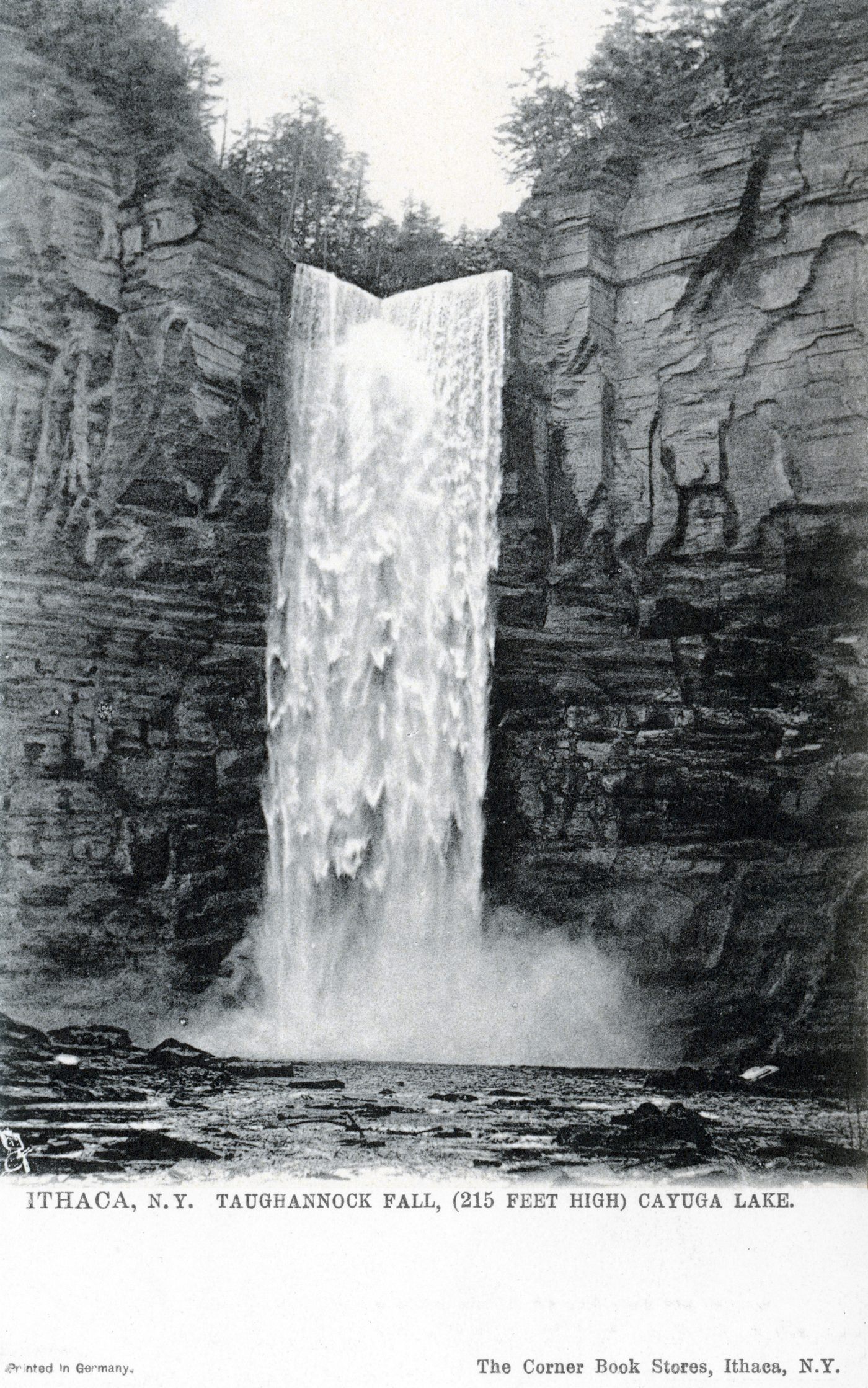
In the same Town of Ulysses, Taughannock Falls plunges 215 feet past rocky cliffs that tower nearly 400 feet above the gorge, according to New York State Parks.6 The state's environmental agency lists it as the "highest vertical single drop waterfall in NE U.S."7 The 1894 county history had already called it the highest perpendicular fall in the state, with a gorge 380 feet deep.1
A Place with Layers
A nickname from a muddy road, a founder with a frostbite story, and a name that may be a clerical slip: Trumansburg's layers are exactly what a good local history is made of. Every place has a story. We help communities share theirs.
Sources and notes
- Landmarks of Tompkins County (Selkreg, 1894), ch. XIII, Ulysses/Trumansburgh: Selkreg, Landmarks of Tompkins County (1894), ch. XIII: Clinton's journal as quoted there, Treman's settlement, frostbite and mill, McLallen's Tavern, the library and the 1864 fire, and the Taghanic Falls figures.
- Ulysses Historical Society, 'A Brief History': Ulysses Historical Society timeline: 1792 arrival, 1794 mill, 1810 Clinton visit, 1811 turnpike and library, 1864 fire, 1872 incorporation.
- Town of Ulysses, 'Local History': Town of Ulysses: the Military Tract, first settlers, and location of Taughannock.
- Village of Trumansburg, 'About': Village of Trumansburg: Cayuga homeland acknowledgment, Treman's Village, the post-office renaming, 1872 incorporation.
- History of Trumansburg (1890), Tompkins County Public Library: History of Trumansburg (1890): the name's shifting spellings called "one of the mysteries."
- NY State Parks, Taughannock Falls State Park: NY State Parks: 215 feet, cliffs nearly 400 feet, park address in Trumansburg.
- NYSDEC, Taughannock State Park: NYSDEC: "215' Waterfall; Highest vertical single drop waterfall in NE U.S."
Photo and music credits
Photographs
- Trumansburg New York Main Street.jpg. Kenneth C. Zirkel, 31 May 2021. Kenneth C. Zirkel (CC BY-SA 4.0).
- First Presbyterian Church front, Trumansburg New York.jpg. Kenneth C. Zirkel, 1 June 2021. Kenneth C. Zirkel (CC BY-SA 4.0).
- Trumansburg New York Village Offices.jpg. Kenneth C. Zirkel, 1 June 2021. Kenneth C. Zirkel (CC BY-SA 4.0).
- Ithaca - Lake Road, Cayuga Lake.jpg. Rotograph Company, 1905. Public domain.
- John Wesley Jarvis - DeWitt Clinton - Google Art Project.jpg. John Wesley Jarvis, circa 1816. Public domain.
- Tompkins County - Taughannock Brook, Cayuga Lake.jpg. Rotograph Co., 1905. Public domain.
- Ithaca - Lower Taughannock Falls.jpg. Rotograph Company, 1905. Public domain.
- Ithaca - Taughannock Falls (1904).jpg. Raphael Tuck & Sons (publisher), 1904. Public domain.
- Taughannock Falls, Ithaca, N.Y (NYPL b12647398-66537).tiff. Detroit Publishing Company, after 1898 (copyright 1900). Public domain.
- Lower Taughannock Falls April 2024.jpg. Awinch1001, 7 April 2024. CC0 1.0.


Music
- Tender Moments Acoustic Loop C.wav. BaDoink. CC0 1.0.