A Plain Brick Chapel
In 1843, a small group of reform-minded Seneca Falls residents formed a Wesleyan Methodist church, part of a national break by antislavery members of the Methodist Episcopal Church. By October of that year the congregation had finished a brick building, 44 by 64 feet, with a gallery on three sides. A period description called it "well finished, though, as it should be, it is plain."1 Antislavery speakers, among them William Lloyd Garrison and Frederick Douglass, spoke there.1 Five years later, it would host the First Women's Rights Convention.
Two Days in July
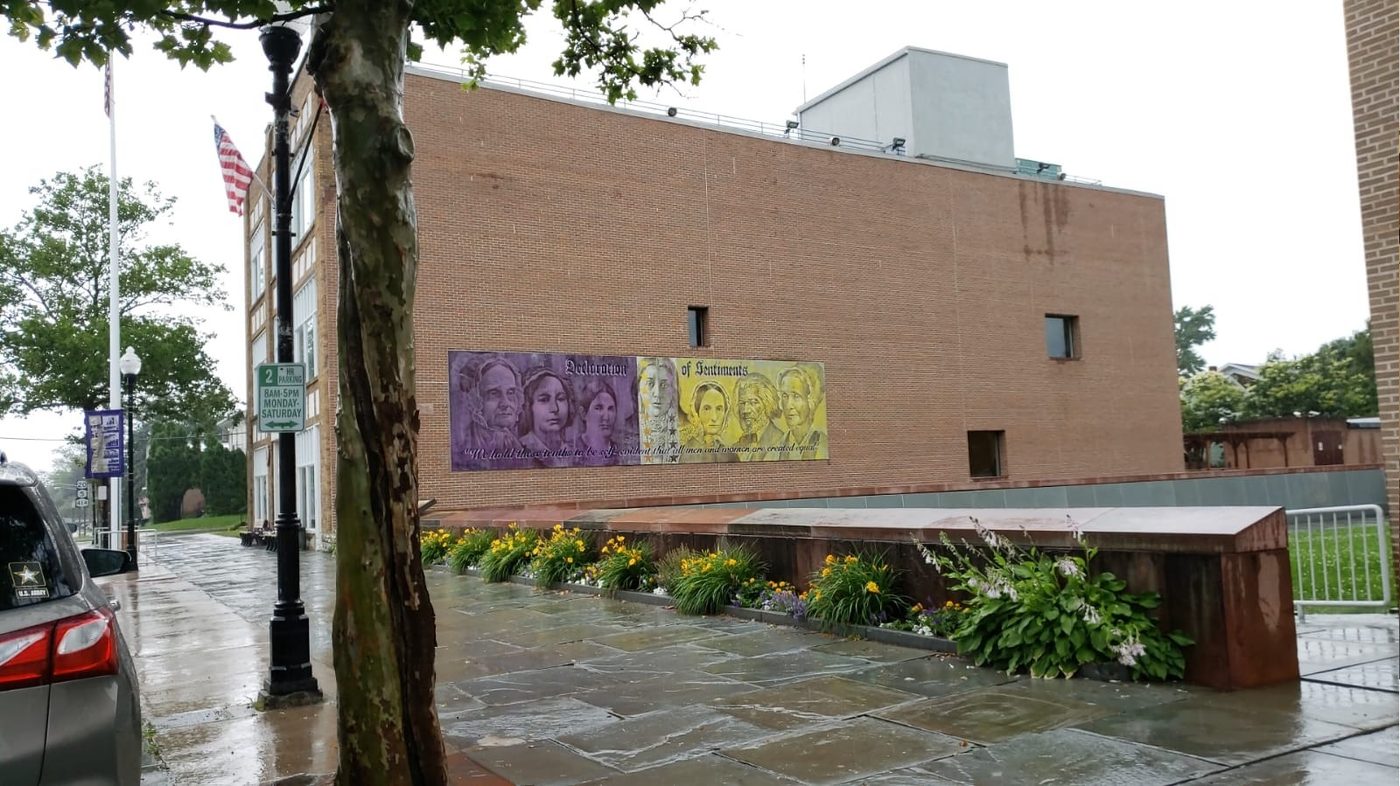
On July 19 and 20, 1848, an estimated three hundred women and men gathered at the Wesleyan Chapel for the First Women's Rights Convention. Lucretia Mott and Frederick Douglass were among them.2 The convention considered the Declaration of Sentiments, drafted by Elizabeth Cady Stanton and the M'Clintock family.2 It was modeled on the Declaration of Independence, and it changed one famous phrase: "We hold these truths to be self-evident; that all men and women are created equal."3
On the morning of Thursday, July 20, sixty-eight women signed. Thirty-two men signed as well, Frederick Douglass among them.4 Only about a third of the people in the room put their names down. The National Park Service notes that for many, signing "may have been dangerous, or exposed them to ridicule," and that the names were published in newspapers afterward, so supporters would not have remained anonymous.5 Today, the full text and every signer's name are inscribed on a 100-foot bluestone wall in Declaration Park, next to the chapel.6
The Lily and the Bloomer
Seneca Falls was home to more than one pioneer. Amelia Bloomer edited The Lily, issued from 1849 until 1853, which the National Park Service describes as the first newspaper for women.7 It began as a temperance journal for the Seneca Falls Ladies Temperance Society, and Elizabeth Cady Stanton wrote for it under the pen name "sunflower."7 In May 1851, Bloomer introduced Susan B. Anthony to Stanton, a meeting now commemorated by a pair of life-sized bronze figures.7
A Building With Many Lives
The chapel's later story reads like a comedy. In 1872 it became Johnson Hall, a public auditorium, and by the end of the nineteenth century the Johnson Opera House. Through the first half of the twentieth century it served as a furniture store, a movie theater, a car garage and repair shop, and a laundromat.1 Still, its connection to the convention was never forgotten: in 1908 Harriot Stanton Blatch, Stanton's youngest daughter, placed a commemorative plaque on the wall.1 In 1980 President Jimmy Carter signed the legislation creating Women's Rights National Historical Park, and in 1985 the National Park Service acquired the chapel.1
Seventy-Two Years
The park service puts the long road in one line: "It would take another 72 years after the convention before women were given the right to vote."1 The National Archives dates the end of that road to August 18, 1920, when the 19th Amendment was ratified, after it was first introduced in Congress in 1878.8
And Bedford Falls?
Seneca Falls also cherishes another claim: that it inspired Bedford Falls in It's a Wonderful Life. The town's film museum says Seneca Falls "has long believed itself to be the inspiration."9 Jonathan Monfiletto, executive director of the Seneca Falls Historical Society, writes that he believes the claims are "valid and credible," but that "there is no primary documentation to support them."10 The museum itself notes that Frank Capra never directly said so.9 We treat it as what it is: a local tradition, loved and unproven.
Every Town Has Its Chapel
A plain brick building, a hundred names, a laundromat, a national park. Every place has a story. We help communities share theirs.
Sources and notes
- NPS, Wesleyan Chapel: NPS: chapel built 1843 by antislavery Wesleyan Methodists; "plain" description; later uses; Johnson Hall; 1908 plaque; 1980 park; 1985 acquisition; the 72-year line.
- NPS, The First Women's Rights Convention: NPS: July 19-20, 1848; about 300 attended; Lucretia Mott and Frederick Douglass; 68 women and 32 men signed; drafted by Stanton and the M'Clintock family.
- NPS, Declaration of Sentiments (full text): NPS: full text of the Declaration of Sentiments, including "all men and women are created equal."
- NPS, Signers of the Declaration of Sentiments: NPS: July 20, 1848 morning session; 68 women and 32 men signed; names include Frederick Douglass.
- NPS, Participants of the First Women's Rights Convention: NPS: 300 attended, 100 signed; names were published in newspapers; signing may have been dangerous or exposed people to ridicule.
- NPS, Declaration Park and Waterwall: NPS: Declaration Park and its 100-foot bluestone waterwall.
- NPS, Amelia Bloomer: NPS: Amelia Bloomer, The Lily (1849-1853), and the May 1851 introduction of Susan B. Anthony to Elizabeth Cady Stanton.
- National Archives, 19th Amendment: National Archives: amendment first introduced in 1878; ratified August 18, 1920.
- It's A Wonderful Life Museum, Seneca Falls connections: It's A Wonderful Life Museum: the town's long-held belief; Capra never directly said it.
- Finger Lakes Times, J. Monfiletto (Seneca Falls Historical Society): Finger Lakes Times, Jonathan Monfiletto, Seneca Falls Historical Society: claims are valid and credible but lack primary documentation; the 1917 Varacalli rescue.
Photo and music credits
Photographs
- Women's Rights Convention attendees.jpg. Unknown (souvenir card of the signers), 1848, later reprint. Public domain.
- Declaration sentiments foote lrg.jpg. Library of Congress (E. C. Stanton / printers of the Declaration of Sentiments), 1848. Public domain.
- Wesleyan Methodist Church Seneca Falls NY.jpg. Kenneth C. Zirkel, 16 August 2013. Kenneth C. Zirkel (CC BY-SA 3.0).
- Wesleyan Chapel, Seneca Falls, interior.jpg. Jane023, 19 June 2019. Jane023 (CC BY-SA 4.0).
- Wesleyan Chapel, Seneca Falls, exterior.jpg. Jane023, 19 June 2019. Jane023 (CC BY-SA 4.0).
- Declaration of Sentiments table.jpg. Unknown author, unknown (the table on which the Declaration was drafted). Public domain.
- Elizabeth Cady Stanton, 1880.tif. Charles Delevan Mosher, 1880. Public domain.
- Elizabeth Cady Stanton.tif. Napoleon Sarony, 1870. Public domain.
- Frederick Douglass by Samuel J Miller, 1847-52.png. Samuel J. Miller, 1847–1852. Public domain.


Music
- Ambient Piano Guitar Texture G Sharp. deadrobotmusic. CC0 1.0.