The Flats, and a Reputation
Before Ithaca was Ithaca, it was a marshy stretch of flat land at the head of Cayuga Lake. According to the city historian, the settlement "grew up at the head of Cayuga Lake and was called the Flats because of its location at the foot of three hills."1 Its early reputation as "a rough and rowdy place" earned it a harsher nickname: Sodom, after the Biblical city of ill repute.1 An 1894 county history lists the early names as "The Flats," "The City," and "Sodom," "according to the choice of different commentators."2 Somewhere along the way, because of the shade trees, some residents even wanted to call it Forest City.1
The name that stuck came from a surveyor. Simeon DeWitt, New York's surveyor general, was an important landowner in the new settlement and a student of the classics. He gave the community the name Ithaca, for the Greek island Ithaki, home of the hero Odysseus, whose Roman name is Ulysses.1 At the time, Ithaca was the chief community in the Town of Ulysses, which carries the hero's Roman name.1 Sources disagree about exactly when the name took hold, so we will leave the date out. We do know DeWitt surveyed 49 lots on an 1807 map, that Ithaca became the county seat when Tompkins County formed in 1817, a village in 1821, and a city in 1888.1
Cliffhangers on Cayuga Lake
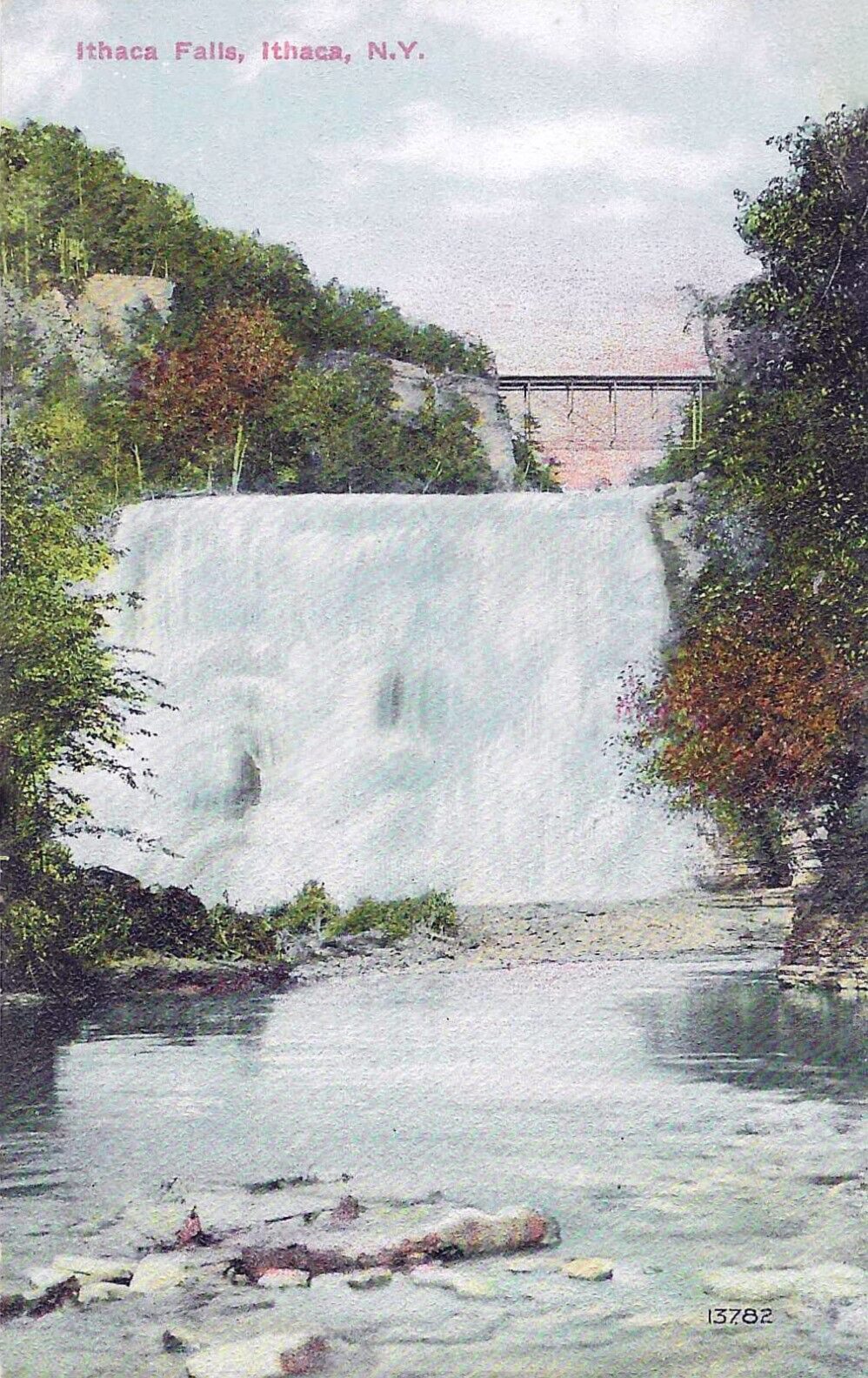
A century later, the same landscape starred in a different story. In August 1914, silent-film serial queen Pearl White spent two to four days in Ithaca and shot some scenes for The Perils of Pauline, according to an Ithaca Journal piece by Walter H. Stainton.3 HistoryNet reports that one of them had her leaping from a ledge into a deep pool at the base of Ithaca Falls.4 The twenty-part serial itself, Stainton stressed, was not made here. Some scenes were.3
The film story that really belongs to Ithaca is the Whartons'. According to the Wharton Studio Museum, brothers Theodore and Leopold Wharton set up Wharton, Inc. in 1915 at Renwick Park, now Stewart Park, on the lake shore.5 The Friends of Stewart Park date the brothers' silent movies at the park to 1915 through 1919.6 The museum describes a town of willing accomplices: when Leo needed a trolley to fly off the Stewart Avenue bridge, the city sold him one, and when Ted needed furniture, houses, "or a surfeit of skunks" for a scene, locals eagerly complied.5 The museum estimates the brothers had a hand in more than 700 films.5
Stainton records other details that sound made up. During production of the Wharton serial Patria, started in 1916, he writes, the dancer Irene Castle arrived "with 2 servants, 3 dogs, 20 trunks, 15 hatboxes, and a pet monkey."3 He also debunked a few legends: the car Pearl White drove, he found, seems to have been a canary-yellow Stutz Bearcat rather than a Rolls-Royce.3 And, he wrote, "Ithaca was never 'the movie capital of the world.'"3 It was a small town with a very busy studio, which is a better story anyway.
A Sweet Claim
Ithaca also stakes a famous claim on dessert. The History Center in Tompkins County tells it this way: on the afternoon of Sunday, April 3, 1892, after services at the Unitarian Church, the Reverend John M. Scott stopped at the Platt & Colt Pharmacy downtown, where proprietor Chester C. Platt served vanilla ice cream topped with cherry syrup and a candied cherry. They called it the "Cherry Sunday."7 The History Center's Sundae Showdown site says Ithaca's claim rests on documented, contemporaneous evidence, and it acknowledges that Two Rivers, Wisconsin, points to an earlier, 1881 origin story.8 A sundae-shaped plaque on the Commons marks the site of the pharmacy, at 216 E. State Street.89
Downtown, Rebuilt
That stretch of State Street has had its own reinvention. After years of urban renewal, Ithaca closed a stretch of State Street and part of Tioga Street to cars. Local histories describe the Ithaca Commons as the first such pedestrian mall in New York, built with local funds.11 The grand opening weekend was September 13 and 14, 1975.10
One Town, Many Stories
Sodom, the Flats, a Greek island, a lakeside film studio, and a pharmacy sundae: that is a lot of story for one small city at the foot of three hills. And it is only the beginning. Every place has a story. We help communities share theirs.
Sources and notes
- Tompkins County Historian, 'City of Ithaca' (J. M. Dieckmann): City Historian's account of the names Flats, Sodom, Forest City and Ithaca; DeWitt's 1807 map; county seat 1817; village 1821; city 1888.
- Landmarks of Tompkins County (Selkreg, 1894), ch. XII, Ithaca: Selkreg, Landmarks of Tompkins County (1894), on the early names "The Flats," "The City" and "Sodom," and on DeWitt as founder.
- Ithaca Journal piece by Walter H. Stainton (forum repost): Walter H. Stainton, Ithaca Journal (reposted on a forum; original date not shown): Pearl White's two-to-four-day visit, "some scenes," the Stutz Bearcat, Irene Castle's arrival, and "never the movie capital of the world."
- HistoryNet, 'Hooray for ... Ithaca?': HistoryNet on the leap into the pool at the base of Ithaca Falls.
- Wharton Studio Museum, 'Wharton Studio History': Wharton Studio Museum: 1915 studio in Renwick Park, the trolley and skunks anecdotes, and the estimate of 700+ films.
- Friends of Stewart Park, 'Waterfront History': Friends of Stewart Park: Wharton silent movies at the park, 1915-1919.
- The History Center in Tompkins County, 'Sweet Beginnings': The History Center in Tompkins County on the April 3, 1892 Cherry Sunday.
- Sundae Showdown (The History Center), 'The History': Sundae Showdown (The History Center): documented-claim framing, Two Rivers, Wisconsin's 1881 story, the sidewalk plaque.
- HistoryForge, Birthplace of the Ice Cream Sundae (216 E State St): HistoryForge: Platt & Colt Pharmacy at 216 E. State St.; the 1956 fire.
- HistoryForge, Ithaca Commons: HistoryForge: the Commons, designed by Anton Egner and Associates; grand opening weekend September 13-14, 1975.
- D. Snodderly, Ithaca and Its Past (1982), pp. 21-23, The Commons: Snodderly, Ithaca and Its Past: the Commons as the first such pedestrian mall in New York, built with local funds.
Photo and music credits
Photographs
- Ithaca - Cascadilla Gorge (1901).jpg. Detroit Publishing Company, 1901. Public domain.
- Ithaca - Cayuga Lake.jpg. Published for The Corner Book Stores, Ithaca by Raphael Tuck & Sons, 1904. Public domain.
- Ithaca - Ithaca Falls (1900).jpg. Detroit Publishing Co., 1900. Public domain.
- Ithaca - Ithaca Falls (1903).jpg. Rochester News Company (publisher), 1903. Public domain.
- Ithaca - Ithaca Falls, 1910s.jpg. Unknown author, circa 1910. Public domain.
- Ithaca Falls by Edwin Whitefield.jpg. Edwin Whitefield, illustrator; J. C. McRae, engraver, 1855. Public domain.
- Ithaca - Ithaca Hotel (1915).jpg. Published for R.C. Osborn & Co, Ithaca by Curt Teich & Co., Chicago, 1916. Public domain.
- Ithaca - Main Falls in Ithaca Gorge.jpg. Hugh C. Leighton Co., Portland, Maine (publisher), 1907. Public domain.
- Ithaca - On Cayuga Lake.jpg. John P. Troy, 1903. Public domain.
- Pearl White - Mar 1916 CM.jpg. Unknown photographer, 1916-03. Public domain.
- Pearl White in The White Moll by Harry Millarde.png. Fox Film Corporation, 2013-07-31 19:08:41. Public domain.
- Ithaca---Renwick-Beach.jpg. Rotograph Co., 1905. Public domain.
- Ithaca - Entrance to Renwick Park.jpg. Published for the Corner Book Stores, Ithaca by the Rotograph Company, 1906. Public domain.
- Ithaca - Cayuga Lake and Renwick Park 02.jpg. Valentine Souvenir Post Card Co., New York City, circa 1915. Public domain.
- Ithaca - Pier at Renwick Park.jpg. Hugh C. Leighton Co., Portland, Maine (publisher), circa 1908. Public domain.
- State Street - Ithaca, New York.jpg. Detroit Publishing Co., 1901. Public domain.
- Ithaca - State Street from Ithaca Hotel (1).jpg. The Buffalo News Co., Buffalo, New York (publisher), circa 1907. Public domain.
- Stewart Park By the lake.jpg. Theodore Wharton, 1915-01-01. Public domain.
- The New Adventures of J. Rufus Wallingford - A Rheumatic Joint (Wharton, 1915).jpg. Unknown photographer, 1915. Public domain.
- Pearlwhite.jpg. White Studio, 1916. Public domain.
- Ithaca - Cayuga Lake, 1900s.jpg. Taylor & Carpenter, Ithaca, circa 1905. Public domain.
- Ithaca - Cayuga Lake from Cayuga Heights.jpg. The Albertype Co., circa 1903. Public domain.
- Ithaca - Renwick Park, Cayuga Lake.jpg. United Art Publishing Co., New York City for The Corner Bookstores, Ithaca, circa 1909. Public domain.


Music
- Free Cinematic Emotional Piano [92bpm] [D Major]. deadrobotmusic. CC0 1.0.